
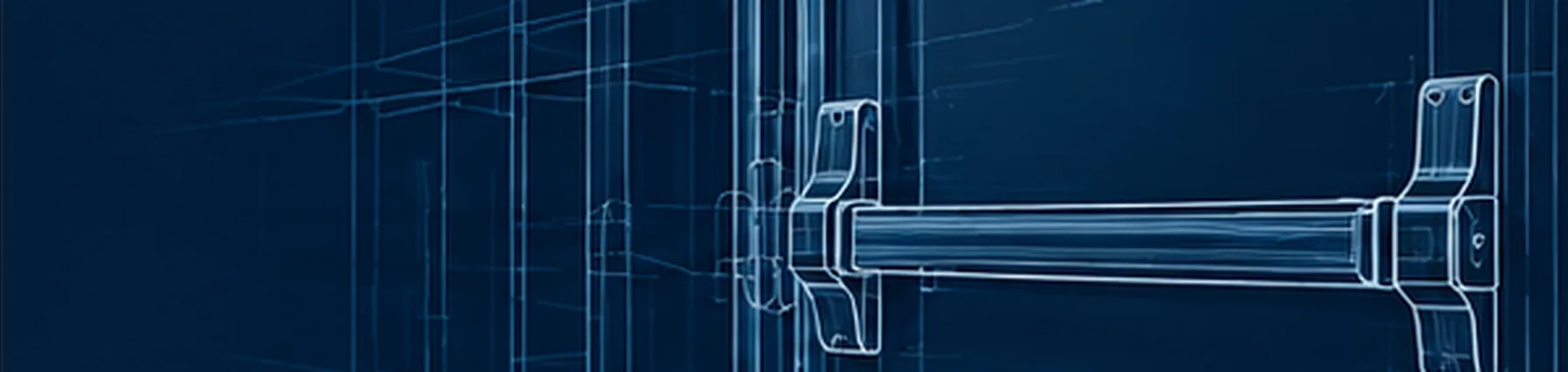
Exit hardware that opens the first time, every time.
Exit devices come with a legal obligation: everyone inside has to be able to get out in one motion, without a key, a tool, or special knowledge. A panic bar that sticks, rattles, or takes a shove is a safety problem and a code problem at once, and it's almost always fixable. Serving commercial buildings across Central New York.
What This Covers
Service & Repair
Sticking latches, rattling push bars, broken dogging, and misaligned strikes. Most exit device problems are mechanical wear that can be fixed in place rather than replaced, as long as the door itself isn't the real problem. I service exit devices from Von Duprin, Precision, Sargent, Corbin Russwin, Accentra (Yale), and other major manufacturers.
Rim, Mortise & Vertical Rod
Each device type fits a different door. Rim devices are the workhorse on single doors. Mortise devices are built into the door edge for a cleaner, tougher installation. Surface and concealed vertical rod devices handle pairs of doors, and their bottom rods and latches take the most abuse: carts, floor wear, salt, and ice. In Central New York, a pair of doors that won't latch in winter is often a bottom rod problem. Choosing the right device for the door and its real traffic is half the job; installing it square and testing it under a hard push is the other half.
Electrified Exit Devices
Electric latch retraction, request-to-exit switches, and alarmed exits tie exit hardware into access control and automatic door operators. They're a common source of service calls when the hardware and the electronics weren't set up to work together.
Egress & Fire Code
Egress doors have to open in a single motion with limited force. Doors on fire-rated openings need labeled fire exit hardware that latches every time the door closes, and fire door assemblies need an annual inspection under NFPA 80. Both are worth checking before an inspector does it for you.
An exit that sticks is not an exit.
These are the problems that turn up in failed inspections. If one of them sounds familiar, it's worth a look before an inspector or an emergency finds it first.
Symptoms Worth a Second Look
- The bar needs a shove to open
- The latch sticks or won't retract
- The door rattles in its frame
- The push bar is loose or drooping
- The door doesn't latch behind people
- A pair of doors won't latch at the top or bottom
- The dogging feature is broken
- Outside trim or an exit alarm isn't working
- An inspection flagged the egress doors
A note on fire doors: Fire exit hardware can't be mechanically dogged. If a fire-rated door needs to stay unlatched during the day, it takes electric latch retraction tied to the fire alarm, not a dogging key. And no exit door should ever be chained, padlocked, or blocked while the building is occupied.
Questions About Exit Devices
- Why does the bar take a shove to open?
Usually the latch is under load. A door that's dropped or a frame that's shifted puts pressure on the latch bolt, so it can't retract cleanly. Weatherstripping that's too tight or building air pressure pushing against the door does the same thing.
The fix is usually alignment and adjustment, not a new device.
- What is dogging, and when is it allowed?
Dogging holds the latch retracted so the door works as push/pull during business hours. It's fine on non-rated exit devices.
It isn't allowed on fire exit hardware, because a fire door has to latch every time it closes.
- Which type of exit device do we need?
It depends on the door. Single doors typically take a rim or mortise device. Pairs take vertical rod devices, or a rim device with a removable mullion.
Fire rating, traffic, and whether the door is electrified narrow the choice further.
- Can we lock our exit doors at night?
You can secure them from the outside, which is what exit devices are designed to do.
What you can't do is anything that stops people inside from getting out while the building is occupied: chains, padlocks, slide bolts, or blocking the door.
- Why does our pair of doors latch at the top but not the bottom?
On vertical rod devices, the bottom rod and latch wear fastest. They get hit by carts and floor equipment, and threshold wear, ice, and salt change how they engage.
It's usually an adjustment or a bottom-latch repair. Some buildings remove bottom rods entirely ("less bottom rod") where the code and the door rating allow it.
Related
Brands I Work With
Von Duprin, Precision, Sargent, and the other exit device manufacturers on Central New York openings.
NFPA 80 Fire Door Requirements
Why fire exit hardware has to latch every time.
ADA Door Hardware Requirements
Hardware height and operation without tight grasping or twisting.
Access Control
Electric latch retraction and request-to-exit, set up to work with the hardware.
Door Closers
A door that won't latch behind people is often a closer problem, not an exit device problem.
Something here sound familiar?
Tell me what the door is doing and what building it's in. A free 15-minute phone consult is often enough to tell whether it's an adjustment or a repair. For a full assessment, the door, frame, and hardware are looked at together, with the findings in writing.