
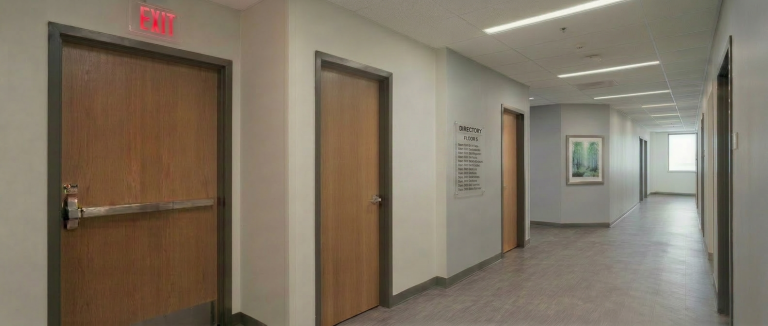
Codes and standards are the legal foundation of the door hardware industry, making sure each opening meets basic fire protection, egress, and accessibility requirements. In most projects, fire doors are governed by NFPA 80, overall life safety and egress by NFPA 101 (Life Safety Code) and the International Building Code (IBC), and accessibility by the ADA and related accessibility standards. The majority of building and occupancy types follow this NFPA 80 / NFPA 101 / IBC / ADA stack, with NFPA 99 (Health Care Facilities Code) adding further requirements for healthcare facilities.
Think of these documents as guardrails rather than step‑by‑step instructions: they don’t tell you every way to design an opening, but they define what must be true when you’re done. This article gives a 101‑level overview of what each code family cares about so you can recognize the issues, even if you still need to open the book for details.
Understanding NFPA 80 and Fire Door Requirements
NFPA 80 focuses on fire door assemblies—door, frame, hardware, and glazing—as tested systems that must hold up under fire conditions. It deals with labeled components, allowed clearances, and how assemblies are installed, maintained, and inspected so they actually perform when exposed to heat and smoke.
At a high level, if an opening is part of a fire‑rated barrier and carries a fire door label, NFPA 80 is in play. That means you need to think in terms of rated components, limited field modifications, and periodic inspections that keep the opening in working order for the life of the building.
IBC Egress and Life Safety Standards
The IBC (and NFPA 101 in many jurisdictions) is concerned with how people get out of a building quickly and safely. For door hardware, that translates into requirements for clear width, swing direction, how many exits you need, and when special hardware—like panic devices, delayed‑egress locks, or controlled egress systems—is allowed or required.
In healthcare and some other specialized occupancies, NFPA 99 and NFPA 101 layer on additional rules about locking, patient safety, and how doors interact with building systems, but the underlying goal is the same: doors must support safe, predictable egress during an emergency. In day‑to‑day work, the key is to remember that not every opening can be locked or controlled the same way—what’s allowed depends on occupancy, occupant load, and the applicable code set.
ADA Accessibility and Maneuvering Clearances
ADA‑related standards focus on making sure doors can be approached, opened, and used by people with disabilities. They set expectations for clear opening width, maneuvering space on both sides of the door, threshold height, hardware operability, and mounting height.
Instead of memorizing every dimension, it’s useful to remember the intent: hardware must be reachable from a wheelchair, operable without tight grasping or twisting, and doors must not require excessive force to open. Maneuvering clearances provide enough floor space for someone using a mobility aid to position, open the door, and pass through without getting trapped. When you see an opening that looks cramped, has hardware mounted unusually high, or requires a “yank” to open, there’s a good chance an accessibility requirement is being missed.
Most modern codes based on NFPA 80 expect fire doors to be inspected and tested at installation and then at least once a year afterward. Those inspections should be performed by a qualified person, with deficiencies documented and corrected so the fire door assembly can still perform as part of a rated barrier.
ADA‑related standards require operable hardware—such as levers, pulls, and panic devices—to fall within a defined range above the finished floor so it is reachable from both standing and seated positions. In practice, many commercial projects set lever hardware in roughly the mid‑30s to low‑40s inches above finished floor to stay comfortably within the allowed range and align with industry norms.
No. ADA requirements apply broadly to many types of public and commercial facilities, not just government buildings or brand‑new construction. Existing buildings often must address accessibility when spaces are altered or renovated, and older facilities are not automatically “grandfathered” out of all accessibility expectations simply because they predate current standards.
No. Panic hardware is required only on certain doors based on occupancy type, occupant load, and how that door functions in the means of egress. Many egress doors can use standard latching hardware as long as they meet rules for releasing with one operation, without special knowledge or tools, and without needing tight grasping or twisting.
The applicable code set is determined by the jurisdiction having authority over the building—often using a specific edition of the IBC and NFPA documents—along with any local amendments. The authority having jurisdiction (AHJ) interprets and enforces those codes, so resolving unusual door or hardware situations usually involves reviewing the adopted code text and coordinating with that AHJ.
A fire door is part of a tested and listed fire door assembly—door, frame, hardware, and glazing—that has been evaluated to resist fire and, often, smoke for a specific duration under NFPA 80 and related standards. A regular labeled door or frame that is not part of a properly assembled and installed fire‑rated opening does not provide the same code‑recognized fire protection, even if individual components carry labels.
Final Thoughts
Codes and standards can be dense, but at a high level they are asking three big questions: Will this door protect the opening in a fire, will people be able to get out quickly and reliably, and can everyone—including people with disabilities—actually use it. NFPA 80, NFPA 101, NFPA 99 in healthcare, the IBC, and ADA each handle a piece of that puzzle, and knowing which document speaks to which concern is the first step in designing and maintaining compliant openings.
When you run into specific or unusual situations, that’s the point where you move from this high‑level framework into the actual code text and, when needed, coordination with the authority having jurisdiction. This intro is here to help you recognize which questions belong to which code so you know where to look next.