
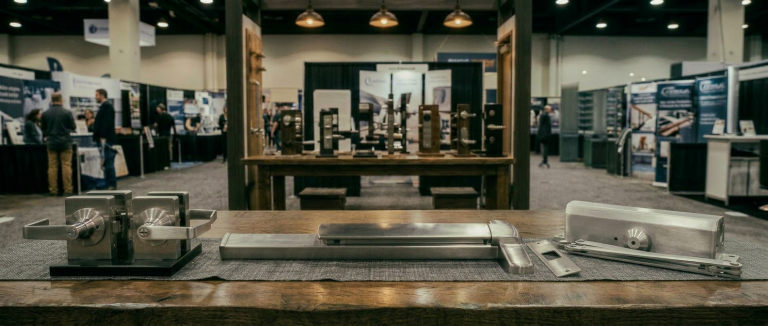
Mechanical door hardware has been the standard for securing and controlling openings for thousands of years, from early wooden pins and bronze hinges in ancient Egypt and Rome to the graded commercial hardware we rely on today. Understanding the different types of hinges, locks, and closers—and how they work together—is essential for maintaining the security and functionality of any commercial building.
If you’re new to the trade, think of mechanical hardware as the “core set” that every opening is built around, even when electronics get added later. If you’ve been in it for years, this is a quick refresher to help you explain choices to customers, coordinate with other trades, and spot problems before they become callbacks.
Hinges, Pivots, and Door Support Systems
Mechanical hardware starts with how you hang the door. Hinges and pivots carry the full weight of the door leaf, control how it swings, and set the stage for everything else to work correctly. Undersized or poorly chosen support hardware shows up later as sagging doors, dragging locks, and closers that seem “weak” even when they’re sized correctly.
Butt hinges are the most common option, especially for standard commercial doors, and are available in different sizes, bearings, and weight ratings. Ball‑bearing hinges and heavy‑duty patterns are designed for higher traffic and heavier doors, reducing friction and extending the life of both the door and frame. Continuous hinges spread the load along the full height of the door edge, which can dramatically reduce wear on the frame and are often used on high‑use or problem openings where standard hinges have failed early.
Pivots are another option, especially on heavier doors or when the design calls for a different swing or aesthetic. In all cases, the key idea is matching the hanging hardware to the door size, weight, usage level, and environment so the door stays aligned and supported over time.
Lock Functions and Security Requirements
Once the door is hung, the next question is how you secure it. Mechanical lock hardware includes cylindrical and mortise locksets, deadbolts, trim, and exit devices, each with different strengths and use cases. The lock function—passage, privacy, office, classroom, storeroom, and so on—defines how the door behaves day‑to‑day and in an emergency.
Cylindrical locks are common in light commercial and many retrofit situations because they’re simpler to install and work well for moderate traffic applications. Mortise locks are typically used where higher durability, flexibility, or security is needed, such as main entries, high‑traffic corridors, or institutional environments. Deadbolts and auxiliary locks add another layer of security but must be chosen carefully on egress doors so they do not conflict with code requirements.
Hardware grades provide a shorthand for durability expectations. Grade 1 hardware is tested to the highest cycle, impact, and strength requirements and is usually specified for heavy‑use commercial and institutional openings. Grade 2 is designed for light commercial or mixed‑use environments where traffic and abuse are lower. Choosing the right grade is less about “good vs bad” and more about matching performance to how hard that door will be worked in real life.
Door Control: Closers and Stop Options
Mechanical door closers control how the door moves, not just how it shuts. A properly sized and adjusted closer manages the opening and closing speeds, the backcheck, and the latching force, protecting both the door and the surrounding walls while helping you meet accessibility and life‑safety requirements. When the closer is wrong for the door size or environment—or badly adjusted—you see slamming, doors that are hard to open, or doors that won’t reliably return to the frame.
Surface‑mounted closers are the most visible and widely used, but concealed closers and floor closers are common in certain applications where appearance or door design demands it. Stops, holders, and overhead checks round out the control package, limiting how far the door can swing and preventing damage to walls, frames, and hardware. Getting door control right is often the difference between an opening that feels “cheap and annoying” and one that feels solid, safe, and easy to use.
Most issues start small: loose screws, dry bearings, or doors that don’t latch cleanly. A simple routine—tightening fasteners, checking that hinges and pivots move smoothly, and making sure locks, exit devices, and closers operate without sticking—goes a long way toward preventing failures and callbacks.
On rated or egress doors, hardware has to do more than just lock and latch—it has to allow free, single‑motion egress and help the door self‑close and latch in an emergency. Adding surface bolts, extra deadbolts, or anything that blocks that path can create a code issue, which is why changes to these openings should always be coordinated with the design team and local code officials.
Start with how the opening is actually used: public vs staff, interior vs exterior, and whether it’s on a primary egress route. Office and classroom functions allow controlled locking from the inside, while storeroom functions keep the door locked on the outside at all times and rely on a key for entry, which is often better for back‑of‑house or secure storage doors.
Cylindrical locks work well for many interior and moderate‑traffic doors and are common in retrofit situations because they’re simpler to install. Mortise locks are typically the better choice for main entries, high‑traffic corridors, and institutional openings where you need higher durability, more function options, and tighter control over how the door behaves long‑term.
Continuous hinges make the most sense on doors that see high traffic, higher weight, or repeated hinge failures over time. They distribute the load along the full hinge stile, which reduces stress at individual hinge locations and can significantly extend the life of both the door and the frame.
The grade is essentially a durability and performance rating based on standardized tests for cycles, strength, and impact. Grade 1 is intended for heavy‑duty commercial and institutional use, while Grade 2 is aimed at light commercial or mixed‑use environments, so the right choice depends on how hard that opening will be worked day after day.
Closer sizing starts with door width and weight, but exterior openings also have to overcome wind, stack pressure, and weatherstripping. Manufacturer charts are the starting point, but in the field it often makes sense to step up a size or use adjustable models, then fine‑tune the closing and latching speeds so the door both meets accessibility requirements and reliably returns to the frame.
Final Thoughts
Mechanical door hardware may not be the most glamorous part of a building, but it’s the part occupants touch every day—and the part that quietly protects life safety and security in the background. Getting hinges, locks, exit devices, closers, and stops roughly right at the beginning prevents a long list of frustrations later: sagging doors, failed latches, slamming closers, and hardware that wears out long before it should.
This article is intentionally broad, meant to give you a workable mental map of how mechanical hardware hangs, secures, and controls a door. Each piece here can be its own deep dive, from hinge selection to closer sizing to lock functions and grades. If you run into a specific hardware problem or have a question about an opening you’re working on, that’s exactly the kind of real‑world scenario that can shape the next article in this series.