
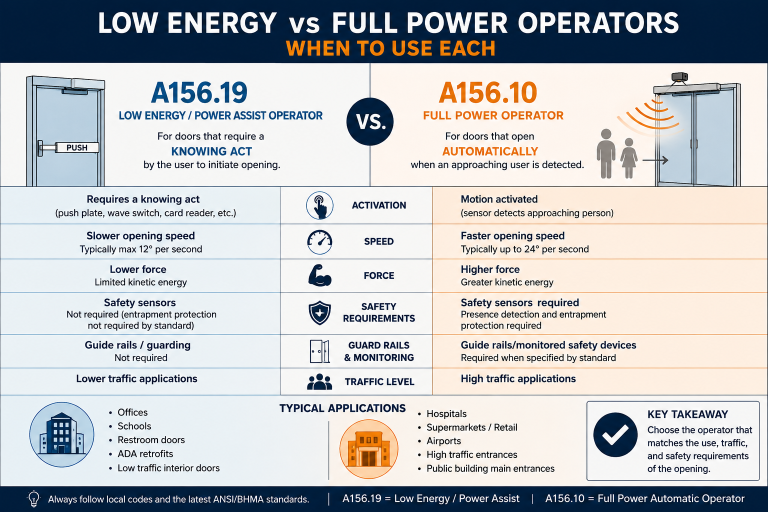
The chart above compares low energy (A156.19) and full power (A156.10) operators at a glance. This guide breaks down what those labels mean on a real opening, when to use each type, and the safety details technicians and facility managers cannot afford to miss.
Introduction to Automatic Door Operators
Automatic door operators are a core part of modern commercial openings because they support accessibility, convenience, and safe movement through a building. Understanding how the operator, hardware, controls, and safety requirements work together is essential for anyone installing, maintaining, or troubleshooting these systems.
Types of Automatic Door Operators
For most field applications, the main distinction is between low energy swing operators and full power operators. Low energy operators are typically activated by a knowing act, such as a push plate, wave switch, or credential reader, and they operate under ANSI/BHMA A156.19. Full power pedestrian door operators are generally sensor-activated or otherwise fully automatic, and swinging applications are governed by ANSI/BHMA A156.10.
Power assist should be understood as a feature covered within A156.19 rather than as a completely separate category. ANSI/BHMA A156.19 applies to power assist and low energy power-operated swinging doors, both of which require a knowing act for activation under the standard. In practical terms, that means a technician may see a low energy operator that opens the door under power, or a power-assist function that reduces manual opening resistance, but both still belong in the same standards family.
A simple way to think about it in the field is this: low energy operators are common on office, school, restroom, and retrofit openings where accessibility is needed without turning the opening into a fully automatic entrance. Full power operators are more common at busy public entrances where higher traffic and automatic activation justify the additional sensing and guarding requirements.
ANSI Safety Standards and Compliance
Low energy and power-assist swing operators are covered by ANSI/BHMA A156.19, while full power pedestrian door systems are covered by ANSI/BHMA A156.10 for the applicable door type. For more technical details on compliance, see our section on Codes and Standards. The A156.19 standard addresses items such as activation, opening and closing force, kinetic energy, signage, switch location, and time delay requirements for covered swinging doors.
A key field distinction is that A156.19 assumes a knowing act to start the cycle, while a low energy operator that opens automatically based on a sensor may need to meet A156.10 requirements instead, including added safety sensing. This is why the same operator hardware can create very different compliance obligations depending on how it is activated and configured. You can find out more about industry standards from the Builders Hardware Manufacturers Association (BHMA).
Any adjustment to speed, force, timing, activation method, or safety devices should be made with the applicable standard in mind. A door that seems to “work fine” can still be out of compliance if the settings, signage, or sensing do not match the standard governing that opening.
Common Installation and Maintenance Challenges
Many operator problems are not caused by the operator alone. Compatibility between the door, frame, hinges, closing force, electrical supply, activation devices, and safety equipment all affects whether the opening performs properly. This is especially important on retrofit jobs, where adding an operator to an existing manual door may be straightforward in concept but still requires the opening to support the operator mechanically and electrically. If you are running into issues, our guide on Field Troubleshooting can help isolate the cause.
Common field issues include poor activation device placement, incorrect settings, weak or inconsistent power, worn hardware, and safety sensors that are dirty, misaligned, or omitted where required. These issues can show up as nuisance reversals, incomplete opening, slow response, or behavior that only fails under certain traffic conditions.
Good troubleshooting follows the same pattern as any other door problem: understand how the opening is supposed to work, observe what it is doing now, and identify when the behavior changed. Once that is clear, isolate the operator, activation devices, safety system, and door mechanics one step at a time instead of changing multiple variables at once.
Low energy operators usually require a knowing act (push plate, wave switch, credential reader) and are governed by ANSI/BHMA A156.19 for power‑assist and low energy swinging doors. Full power operators are typically sensor‑activated, move with greater speed and kinetic energy, and must meet the safety and sensing provisions of ANSI/BHMA A156.10 for automatic pedestrian doors.
Industry guidance and programs like AAADM recommend inspection at installation and at least annually thereafter by a qualified or AAADM‑certified inspector, with high‑traffic entrances often needing more frequent checks. Many facility safety and risk‑management programs now treat documented annual inspections as a de‑facto requirement, not just a best practice.
In many cases, yes. Existing manual doors can often be retrofitted with automatic operators, but the opening must be evaluated for door and frame condition, power availability, hardware compatibility, fire‑door/egress requirements, and the correct safety devices. A retrofit should never be treated as simply “bolting on” an operator; the completed opening still has to meet the applicable ANSI standard and the building’s safety expectations.
Low energy operators that are activated only by a knowing act and meet all A156.19 speed/force limits may not require additional presence sensors, depending on the application. However, once you introduce automatic activation by motion or presence sensors—or conditions where someone could be in the swing path during the cycle—A156.10‑style safety sensing and monitored sensors can become required.
Yes, daily safety checks are strongly recommended: walking test patterns through the activation and presence zones, confirming the doors open smoothly, remain open when someone is in the path, and close without striking or trapping users. AAADM publishes simple checklists so staff can verify basic operation each day and call a qualified technician when something changes.
The accessibility standards focus on clear openings, reach ranges, and opening forces; they do not mandate automatic doors on every entrance, but automatic or low‑energy operators are one common way to meet usability expectations at key doors. Many healthcare, retail, and campus facilities choose automatic doors at primary public entrances to improve accessibility, traffic flow, and user experience even when not strictly required by code.
Final Thoughts
Automatic door operators sit at the intersection of mechanics, electrified hardware, controls, accessibility, and life safety. The technician who understands not just the operator but also the governing standard and the rest of the opening will make better installation decisions and solve problems faster.